-
Recent Posts
Recent Comments
Archives
Categories
Meta

(first published in the Transbay Calendar/newsletter around 2002)
There have been some in this scene who, in years past — back when the testosterone levels weren’t perpetually spiking in the DUI range — who asserted that improvisation is a method, not a style (I was one of those who said so). I think that’s really the whole point of Derek Bailey’s Improvisation: its nature and practice in music — he’s saying, look at all this improvisation in different styles, but there are commonalities in the method, independent of style. Okay, it’s not the whole point of the book, but it’s a biggie.
That’s the ideal, but in practice it turns out that some players have succeeded in turning the method into a style, mostly made up of its own hermetic grab-bag of cliches. I won’t say who. As usual, it isn’t meekness or niceness that prevents me from naming names, but simply good sense — these, after all, are just my opinions: who’s “good” and who’s “bad.” Why stomp on somebody who’s working their shit out? Why invite pointless arguments about improvisor A versus B? (In other words, why add more manure to the same tiresome poop-pile that now shadows the local dialog? Besides, I’d be pointing the critical finger at myself, much of the time.)
However, I’m more than ready to name some of the gambits that have helped turn certain kinds of improvisation into style[s].
Gambit 1: Play only with those who you are certain share your particular esthetic.
This is the opening gambit. Assures you of “esthetic consistency” and “agreement” and, ultimately, screens out a rich source of spontaneity (a key energizer of improvisation). This gambit partially depends on Gambit 5 (below), identifying yourself/your music with a certain “school.” Free jazzers don’t play with noise boys. New-classicals don’t play with rockers. Glitch-hoppers don’t play with lower-casers. Boys, by and large, don’t play with girls. And so (yawn) on.
Gambit 2: Don’t talk about it!
After all, the argument goes, one can’t really talk about music in a meaningful way! “Writing about music is like dancing about architecture.” I used to buy that line, myself. I don’t anymore. Talking about what you’ve just played can be a powerful tonic in the aftermath of something that hasn’t quite worked out, and for a practicing ensemble, it’s essential to ensure that progress is actually achieved in finding a group voice and a group self-awareness. Talking also has the uncomfortable effect of identifying cliches, favored fingerings and other non-spontaneous glitches in one’s playing. And these are not allowed, so even though they’re often there, we just won’t talk about them. Better yet, let’s don’t talk about anything (except all the names we can drop.) Anyway, talking about what you’re about to play is — gasp! — the same as composition! And we can’t have that.
Gambit 3: Extend that technique!
This is a hard one for me to pick apart, as it’s something in which I’m personally heavily invested. But, to extend the self-critique, I’ve realized that lately I’ve been limiting myself needlessly by ignoring things like tone, phrasing, dynamics, in favor of how much sheer sonic hell I could generate with a new embouchure. The exploration of new sounds and techniques seems an inextricable part of music’s progress, and there will always be someone there to do it, but a singleminded focus on this one aspect of music — especially on the bandstand, where it’s tantamount to practice and not performance — is numbing. I see people indulging in this at practically every show I attend.
Gambit 4: Surround yourself with mystical mumbo-jumbo.
I’ve already alienated some friends with this one, but I stand my ground. The problem is not that you’ve had, as a performer, an experience of the divine onstage. (That’s between you and your idea of whatever “higher” power or entity you bow towards.) The problem is, threefold: First, you might very well be the only one up there having the experience. Everybody else is looking at you as if you’re a divine wanker, while you go on, listening to your muse and nobody else. Second, how do you bring it back down to Earth? How do you tell people about what you’ve seen, without either trivializing it or coming off like a UFO abductee? Third, are you using mysticism as a convenient avoidance of self-analysis? Mystical experiences are hard to explain or describe or deconstruct, so this gambit becomes really a subset of Gambit 2: Don’t talk about it, but rhapsodize instead about the “transmission through my Self of divine inspiration.” Shit, you can’t criticize Heaven, can you? The Gods are always right! I won’t deny that there’s something extraterrestrial about a really great performance, but cherishing that memory shouldn’t be an excuse to shun analysis and reflection on it. Sincerity is the cheapest of virtues, meaning: It’s easy to believe mindlessly; It’s much harder to believe and present a robust critique.
I will mention only in passing that there’s already a style of music closely related to freely improvised musics that has a heavy mystical element to it (called, variously, “ecstatic” or “energy” music, or, closer to the source, “free jazz”), thanks mainly to the long, deep shadow of John Coltrane (Ohnedaruth), whose memory now has its own church devoted to it.
Gambit 5: Proclaim yourself part of a “school” or “tradition.”
That way, you don’t have to think or talk, ever! You can just quote liner notes about this-and-such or so-and-so.
Gambit 6: If it sounds good, do it again! (and again and again and again…)
This is the tiredest cliche in the book. I know, because I do it all the time. And I hear others doing it all the time. Yecch.
Gambit 666: DON’T EVER REPEAT ANYTHING.
This is the second-tiredest cliche. To dig a little deeper into the deadly dyad of Gambits 6/666, let’s look at how and why repetition is utilized in improvised music. There are times when a repeated phrase or sound acts as a defining structural element. Matt Ingall’s recent solo performance at the Skronkathon BBQ provides a good example, where, after running through a little Mozartmuzik, the clarinettist gradually broke down the harmonic/melodic elements into an unending circular-breath workout (that had its own kind of “ecstatic” energy). Another is Roscoe Mitchell’s opening solo improvisation on the album Nonaah, wherein he mechanically repeats an off-kilter phrase from the eponymous composition for several minutes, until the audience is screaming at him. Finally the tension breaks, the notes change, and by the end the audience is cheering wildly. This perverse gambit turns an otherwise static, pedantic improvisation into a truly extraordinary, unforgettable exercise in tension and release, and asymmetrical form.
There are likewise moments in improvisation where repetition is a spontaneous discovery that is non-repetitive on a “meta” level. Sonny Rollins blasts into hyperdrive during his well-known (studio) solo on “St. Thomas,” by the use of a simple repeated six-note figure, wedged into an otherwise dense and baroquely filigreed bebop excursion. The repetition sounds non-repetitive simply because the event in toto is such a contrast to the harmonic/melodic maze that surrounds it. Again, the tension-and-release model gets a workout, too.
Another type of repetition is employed by lesser talents. This involves a brand of narccisistic onanism where the player executes a phrase s/he likes (“Ooh! That’s a keeper!”), and gratuitously repeats it, with or without variations, simply for the pleasure of hearing it some more and reinforcing the positive feedback loop. This is the essence of Gambit 6. It almost never adds to the sound, structure, or momentum of the music.
What I call gambit 666 is simply the ossification of an unwritten rule of the “non-idiomatic” school of free improvisation. Always being different, good. Repetition, baad. Virtually every “idiomatic” music uses repetition, so, logically, “non-idiomatic” music must eschew it. What a shock it must have been to the Euro-improv establishment when the quartet Alterations started inserting bits of pop songs, Reggae rhythms, and funk riffs into its otherwise approved non-idiomatic improvisations!
Obviously, repetition is an important factor in music. It helps our memory piece together a pattern in the musical fabric (as Feldman expressed it). Since a piece of music unfolds over time and can’t be apprehended “at a glance” — unlike the surface of a painting — virtually every piece of music must address repetition in some way. Unconditional avoidance doesn’t make it any less important. It just results in a different kind of pattern, since our brains can’t help but find patterns — even when there are apparently none.
So, in the pre-programmed flight from repetition and pattern, the “free improvisor” becomes quite a bit less free, and paradoxically makes the music more patterned and predictable. I might add that this gambit is probably the most virulent strain of stylization that afflicts freely improvised music.
Gambit 7: Canonize your heroes.
— and try to play like them. And argue endlessly about who’s better, and who’s suffered more for their art, and who’s more influential, ad nauseum. You don’t ever have to question what they’ve done, i.e., improve upon it, or go deeper.
Gambit 8: Gig more, rehearse less.
After all, if what we’re doing is spontaneous, shouldn’t what we do on the bandstand be untested, totally new? Then why rehearse? That’d kill the spontaneity!
Gambit 9: Keep churning.
Don’t stop the flow. The flow must go on. I have seen Very Famous Improvisors (is that an oxymoron?) commit this crime, past the point of annoyance — they just go and go and keep churning out sound. To stop might sound like we’re lost, or we don’t know what to do next. To stop — might allow something different to happen rather than the highly virtuosic show of technique and listening which has been honed over years and years of playing. We’re professionals, this attitude screams. You will be impressed. Okay. But is something truly unexpected and fresh going on? This is where professionalism becomes tyranny. Watching really impressive technique can be like watching an expensive Hollywood movie, where one becomes more conscious of the money being exploded all over the screen, than of the plot or characters — because, after all, the “FX” is the product really being sold.
Epilogue, and a final Gambit.
It’s tragic when something that prides itself on spontaneity, freshness, and the constant skewering of expectations morphs imperceptibly into its opposite. But it’s probably inevitable. Everything changes — even that which is supposed to be always changing.
It’s not impossible to overcome these deadly gambits. Free improvisation must always base its practice first and foremost upon listening. Listening is the one thing — call it a method if you like, but it’s woven deeper into the fabric — which remains fresh, because it’s about dealing with what’s right in front of you, the player, right now. And, of course, this rule creates its own exceptions — and traps. Great music need not be a slave to the listening gambit!

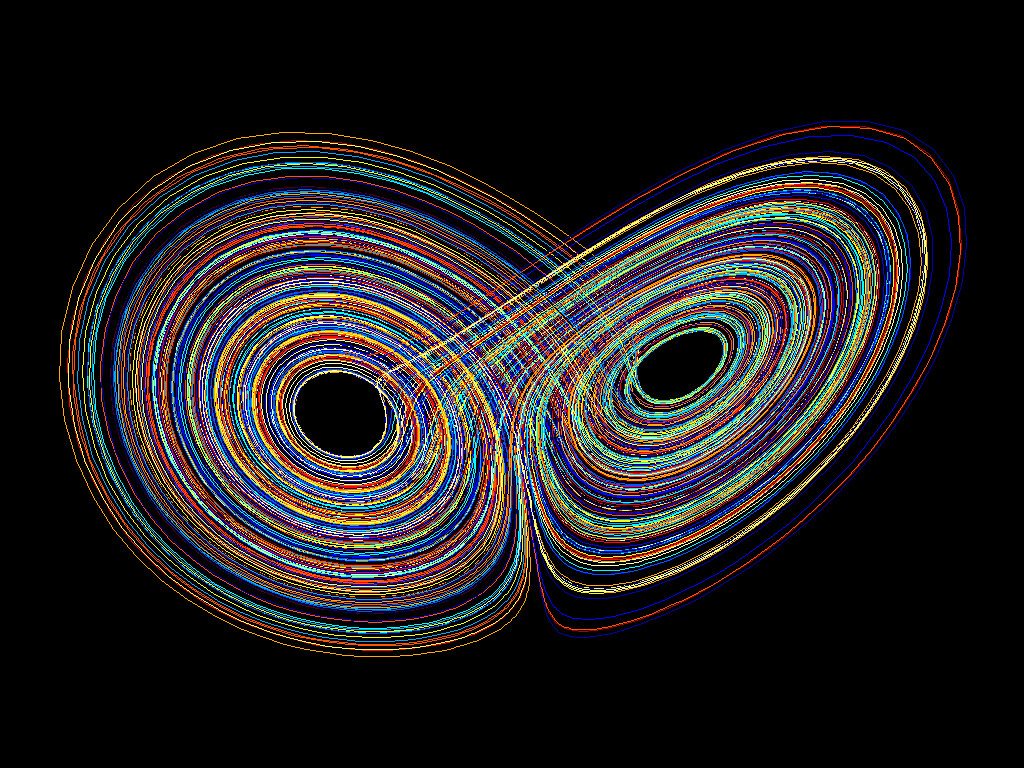
Recently, the poetry that swirls around chaotic processes has infiltrated my thoughts, given rise to new ideas and connectivities. The instruments I use, based around Rob Hordijk‘s rungler circuit, function via the double-well principle (sometimes called “strange attractors”); they settle into patterns that remain in place until a new condition, or stimulus, is introduced into the system. What I like to tell audiences is that, alongside the dynamics of random event generation (not well-received technoblather among non-techies), chaotic systems are always seeking stasis — or “peace,” if you will. Anyone can relate to this, lending my presentations a resonance which elevates a concert of abstract sound generation into an ecstatic immersion. I like to draw audiences into what I’m doing gradually and, in a manner of speaking, unfold an outward-facing synaesthesia of abstract sounds connected with speaking.
In June 2024 I did one of these shows to a sellout audience at CNMAT in Berkeley.
It turns out that there is a ‘poetics of chaos.’ A chaotic system, far from the popular conception of the inside of a tornado — violent, uncontrollable, never-ending disaster — is constantly seeking stability. It’s just like you and me! It wants peace and stability. It will settle into comfy stasis and never get up from the easy chair again, if there are no new conditions introduced into it. A chaotic system starts from a discrete set of variables that determine where it will end up. Thing is, even with the same opening conditions, it doesn’t reach the same outcome with each iteration. Launch it, and it may head not for Mars but straight into the sun, or into the nearest 7-11. Even with the same initial conditions, the trajectory cannot be predicted with certainty.
Each day, most of us wake up with more or less the same initial conditions as the day before. But the day never ends up in the same place. It’s chaos. You could wake up, get out of bed, and die: that’s chaos. In fact, this particular outcome already happened to somebody, you can be sure. Somewhere, sometime in the vast pantheon of human history, some poor schmoe woke up, said, “Jeez, what a great day! I can’t wait to get started!” — then slipped on a banana peel, or a banana slug, or a slug of whiskey, or a whisk broom, keeled over and put their face through the window-pane, or that heavy glass ashtray they never could stand or that sharp corner of the night-stand, and, boom. Gone in a minute. This is living, and dying, with chaos in action. The multiple-universe theory gives a daunting picture of chaos emerging, and leading to a new possible universe existing alongside the one we think we’re living in, every moment. Every possible outcome is emerging, already, all the time.


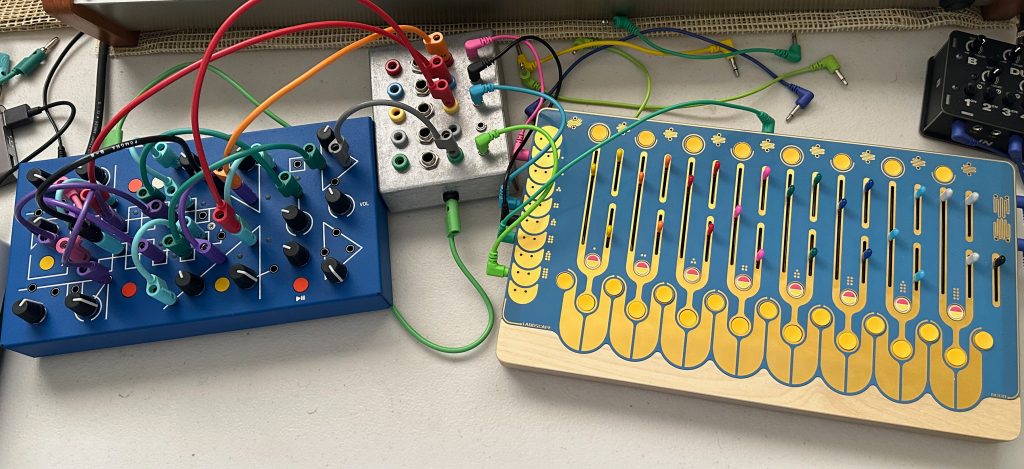
Having recovered from a demanding/rewarding Europe trip that filled all of May and June 2023, I spent July and August recording and learning some new gear, not always in that order. Some of the results can be heard on the recording the album THISTLE, which exploits the Landscape NOON, a highly idiosyncratic, not to say subversive synthesizer, billed as a “drum machine” but not really. The thing about it that’s so unusual is that the circuitry is entirely passive. It doesn’t use any constant power source such as batteries or a 9 volt DC converter. Nothing plugs in except whatever control voltages you put into it (also audio). These voltages provide the power to start up whatever channel you plug it into. As soon as that voltage stops, the channel powers down again. The sounds of the electronics powering up and down in this fashion shapes the sound to a tremendous extent. It is the essence of NON-LINEARITY. In addition to sounds from the NOON, there are a few dozen other sound sources and voltage sources that populate the tracks with snapping, hissing, popping, crispy-fresh free jazz funck. You can hear the results here.
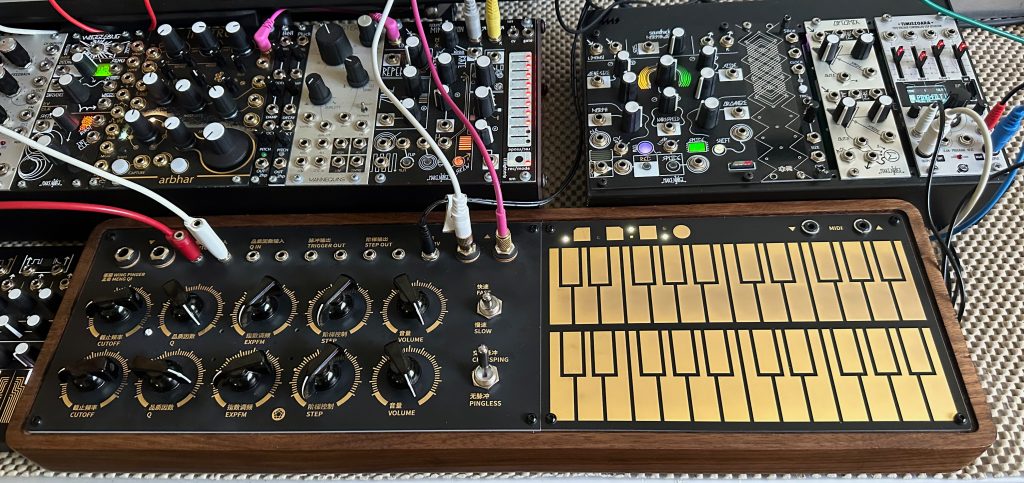
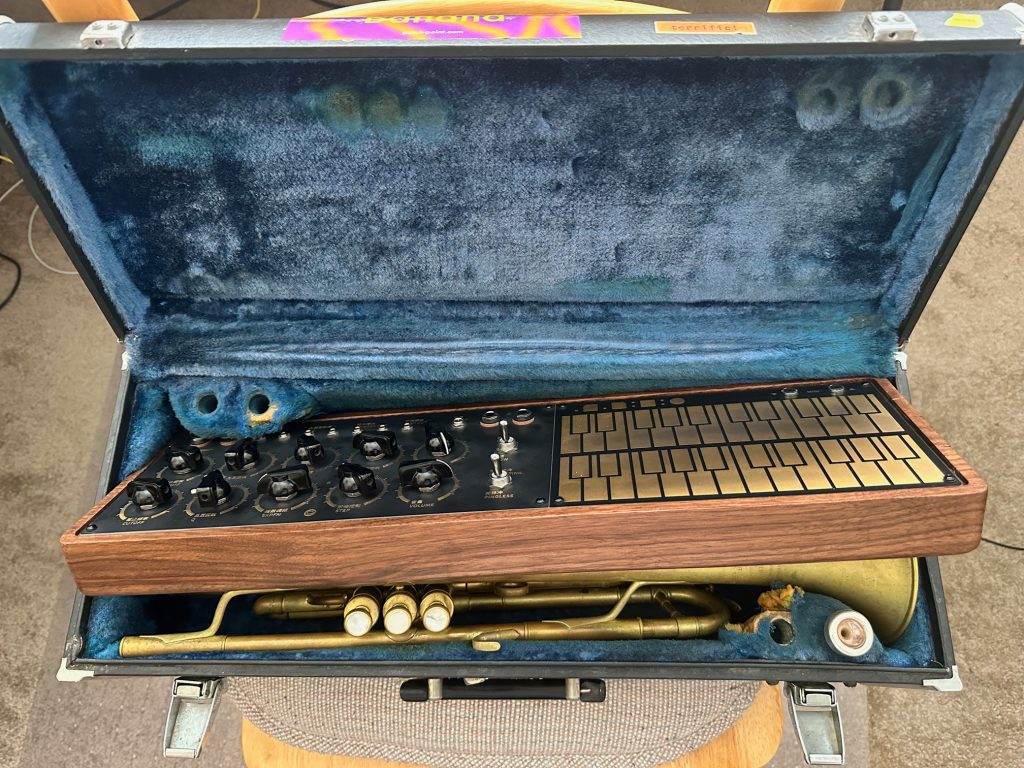
The Wing Pinger is a more peace-oriented bit of kit, although it, too, can bring in da knoise, when pushed to the edge. It is very much an instrument that runs on “edginess,” the edge being the crest of resonance that each of two filters is designed to generate. It’s feedback, pure and simple, albeit highly controllable. From that resonance are derived voltages which are used as data points to populate two shift registers, from which are extracted further voltages used to drive the other parameters of the instrument. The entire architecture was inspired by the work of the late Rob Hordijk, inventor of legendary electronic instruments the Blippoo Box and the Benjolin. In addition, the Wing Pinger sports two touch-sensor keyboards as well as control inputs, MIDI ins and outs, and audio inputs (to process other instruments or sounds). I’m enjoying it all a hell of a lot. It can proceed smoothly from peaceful drones or placid major-pentatonic bells to dancing kalimba sounds and video-game PWEENGs to sheer hellish sonic wall-dom. No sonic samples online as of this blogging.
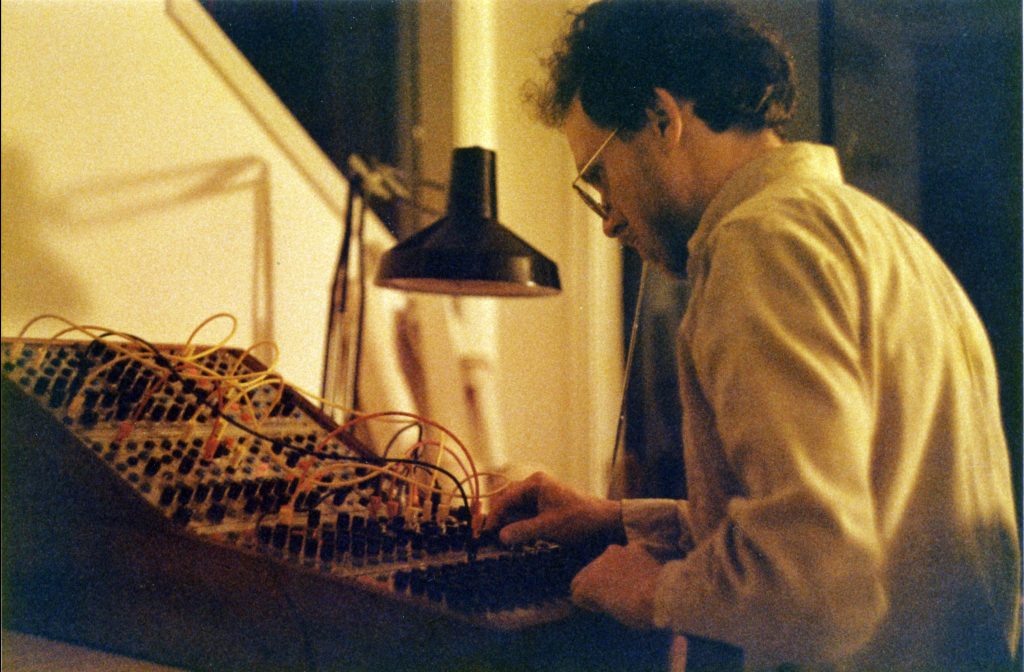
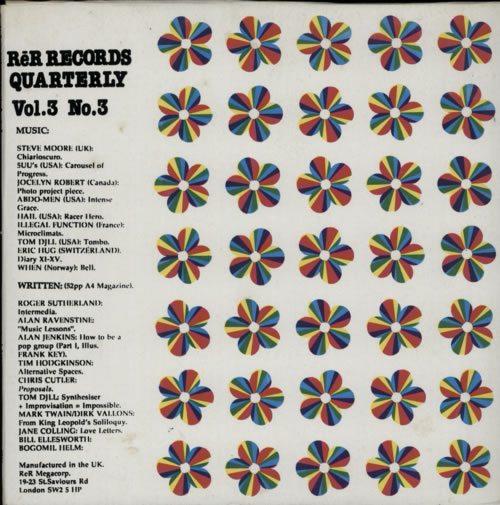
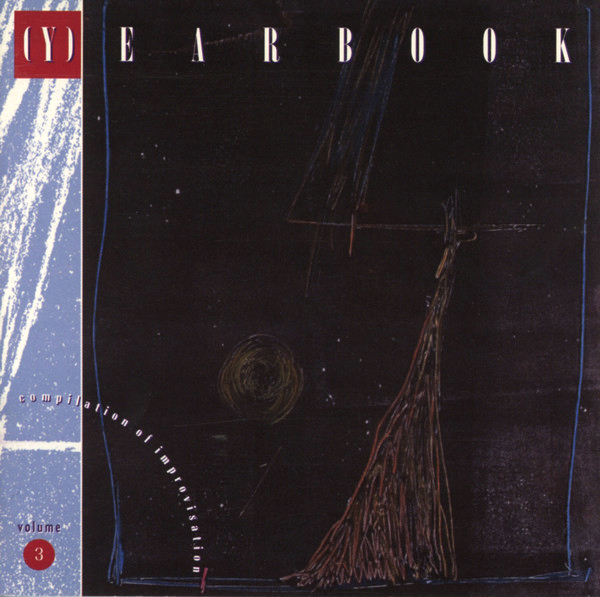
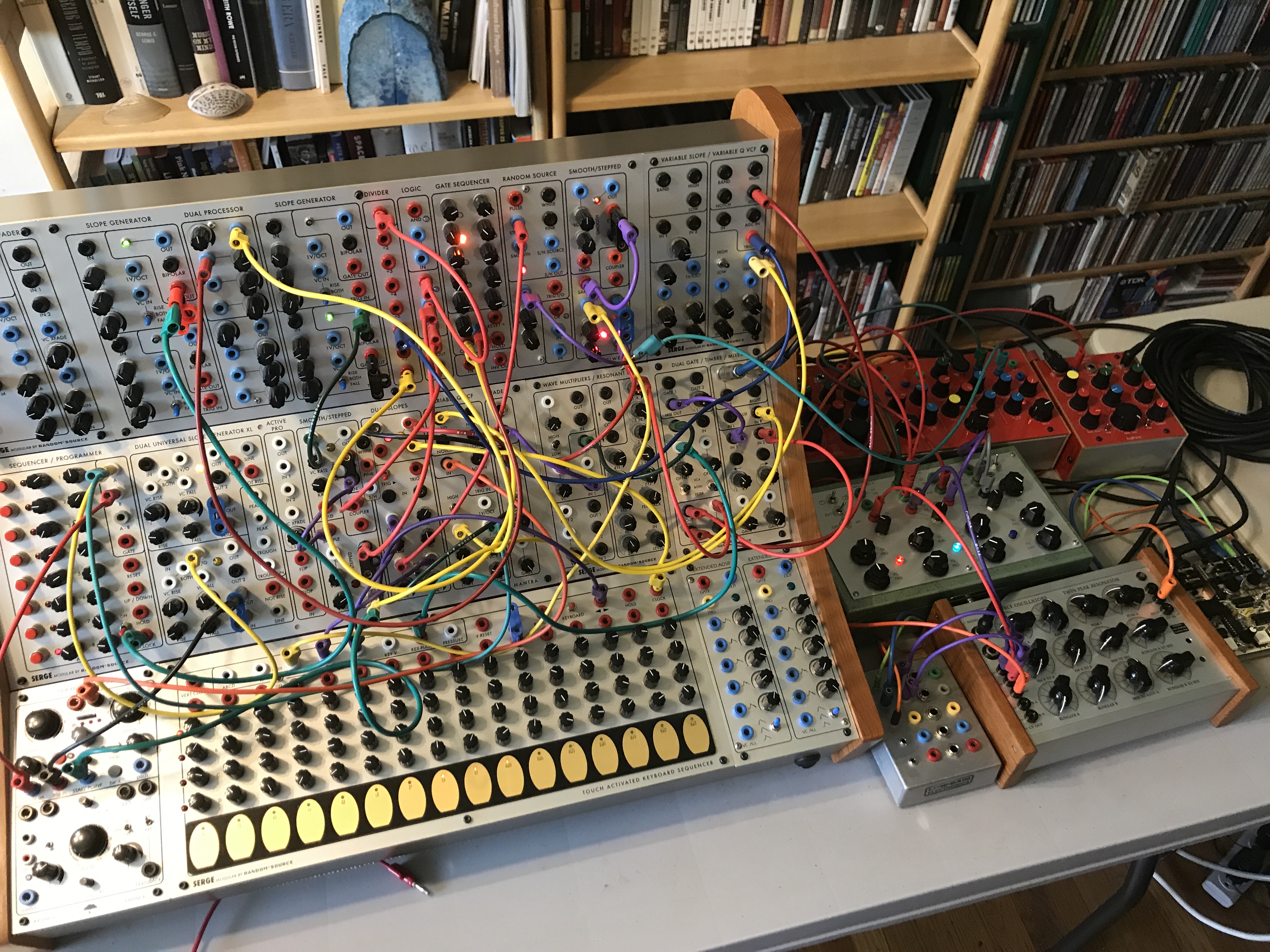
Five years ago saw the Other Minds release of TOM DJLL: SERGE WORKS, (Here on Bandcamp) an overview of improvised and composed electronic music I did in the 1980s, using the Serge Modular Music System. Usually, trumpet was involved. The piece titled TOMBO was published in Chris Cutler’s ReR Quarterly Vol 3 # 3, 1991, along with a letter I had written which Cutler printed under the title “Synthesizer + Improvisation = Impossible?” (The letter was a scream of protest against what we today call presets. I didn’t have any idea he would publish it.) Around 1990 I added a digital delay, the Digitech RDS 7.6 TIME MACHINE. It was a far more affordable (and noisy) copy of the legendary Lexicon PCM 42. Via the TIME MACHINE I was able to live-sample my trumpet, or anything else, and further process it through the Serge system, or use the latter as a kind of backup band for trumpet craziness, and so on. I even did some ‘plunderphonic’ work with this setup, as heard on Rastascan’s compilation (Y)Earbook Vol. 3. (Here on Spotify)
Anyway, Bay Area writer and blogger Stephen Smoliar did a nice writeup of SERGE WORKS on his blog The Rehearsal Studio.


I didn’t take this to Europe…
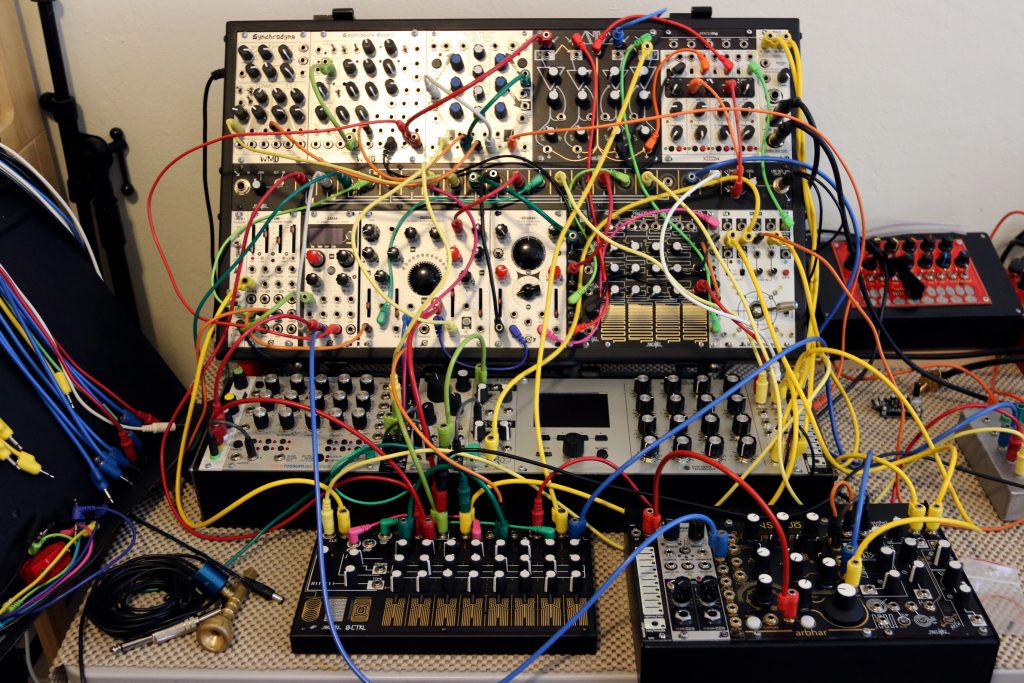
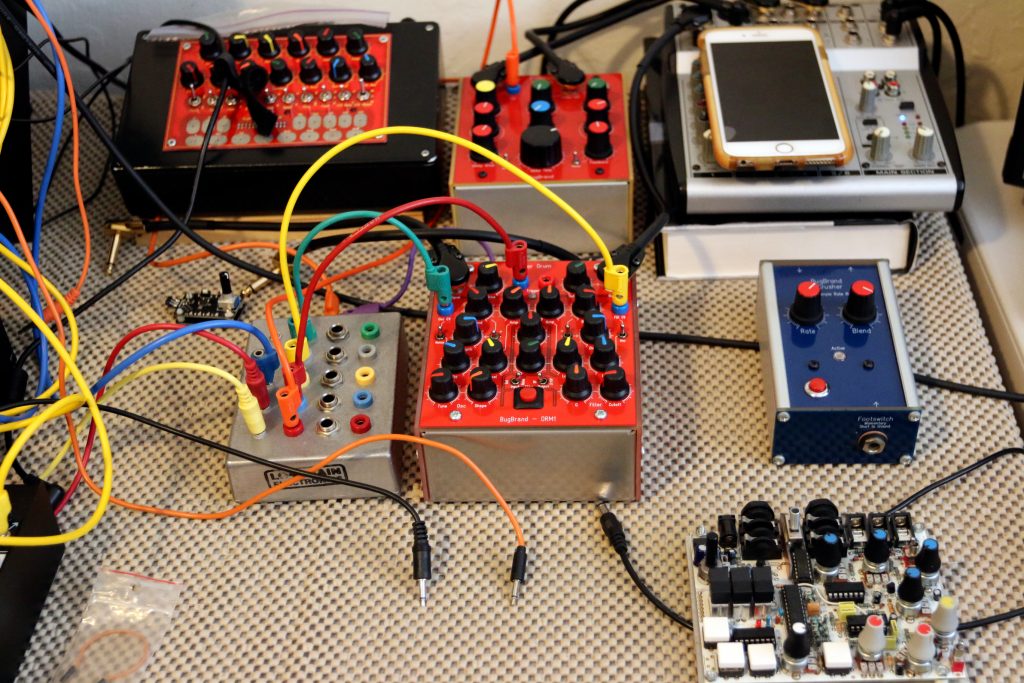
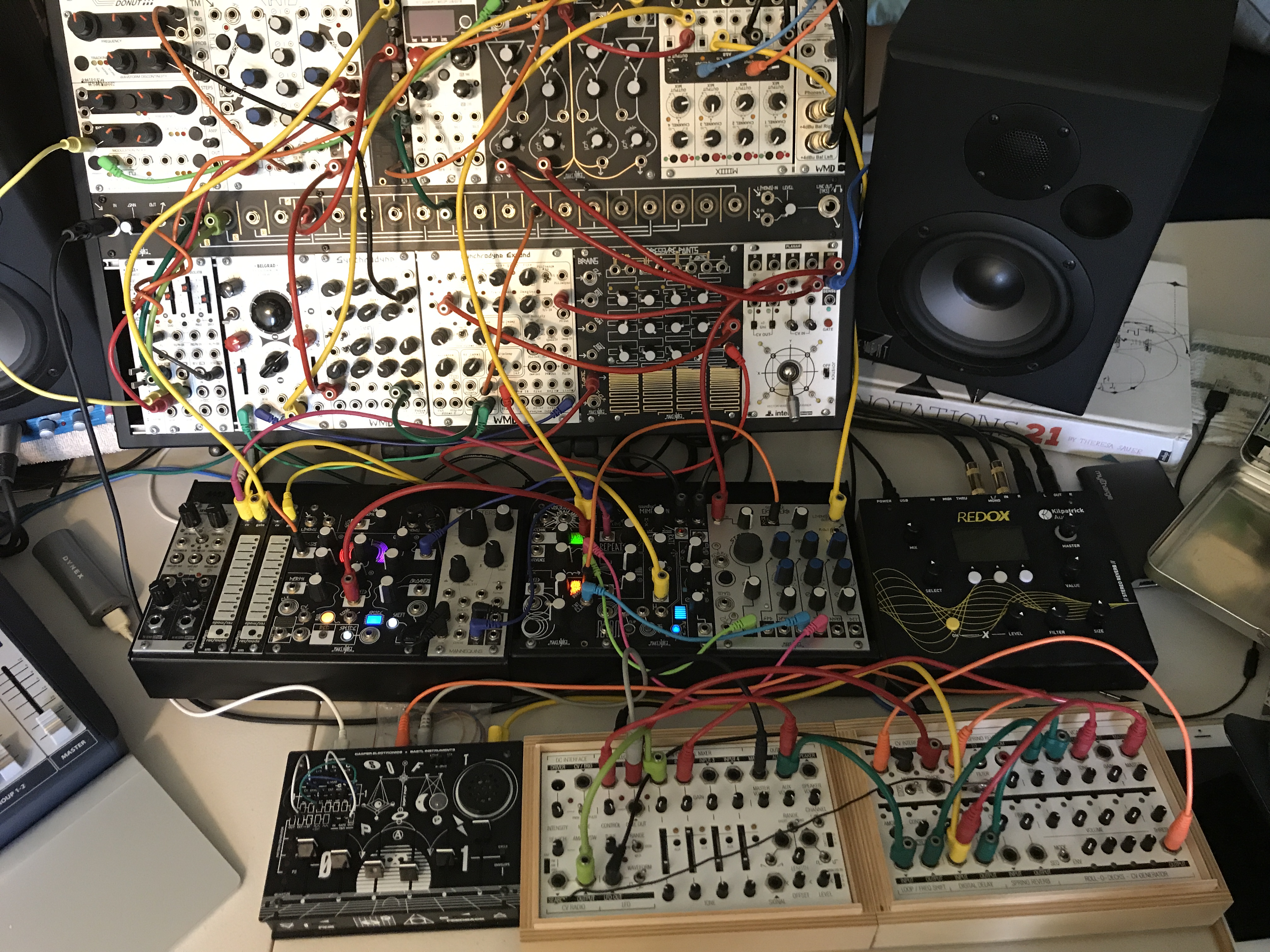
Didn’t take all this Eurorack or Bugbrand stuff, either:


And I left the VCS3 with my friend Clarke for safekeeping.
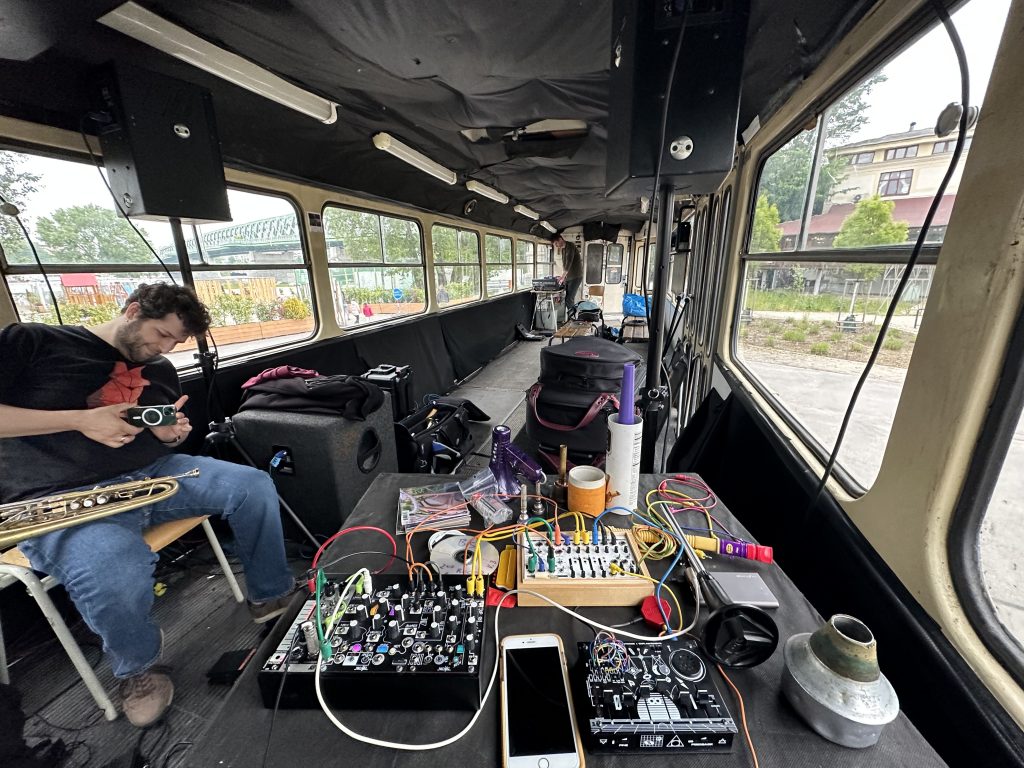
Here’s the rig I toured Europe with. Vienna, Czech Republic (and Slovakia), Germany, Sweden, Norway:

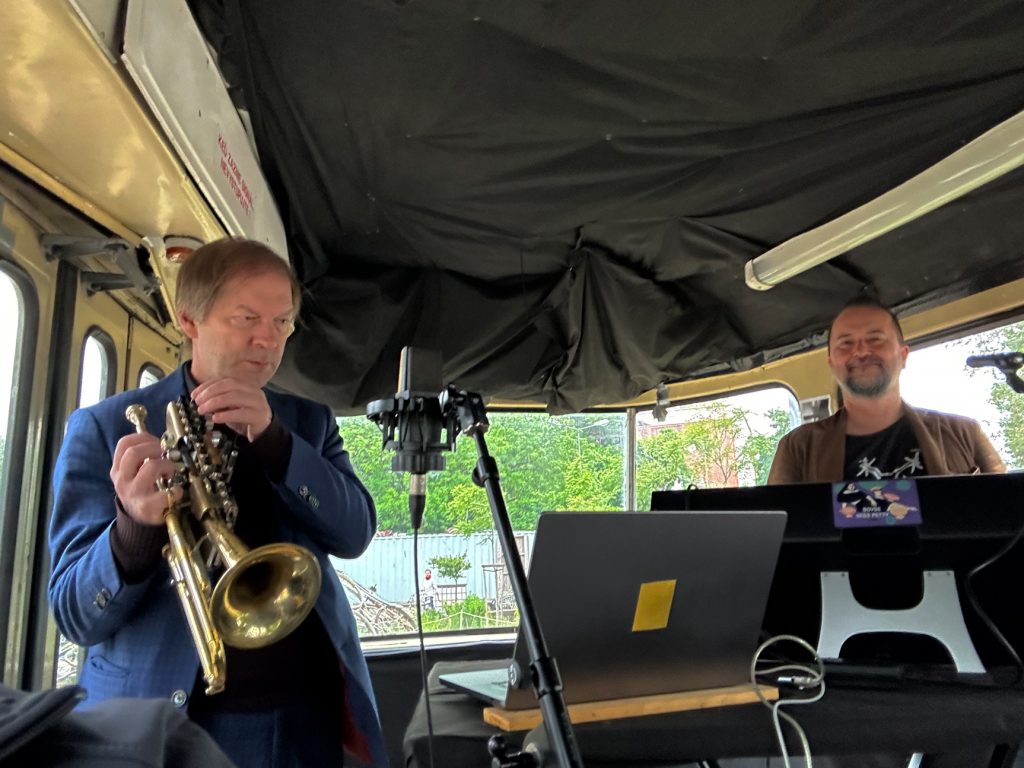
Behind me, Petr Vrba(r) and Axel Dörner(l) were setting up.

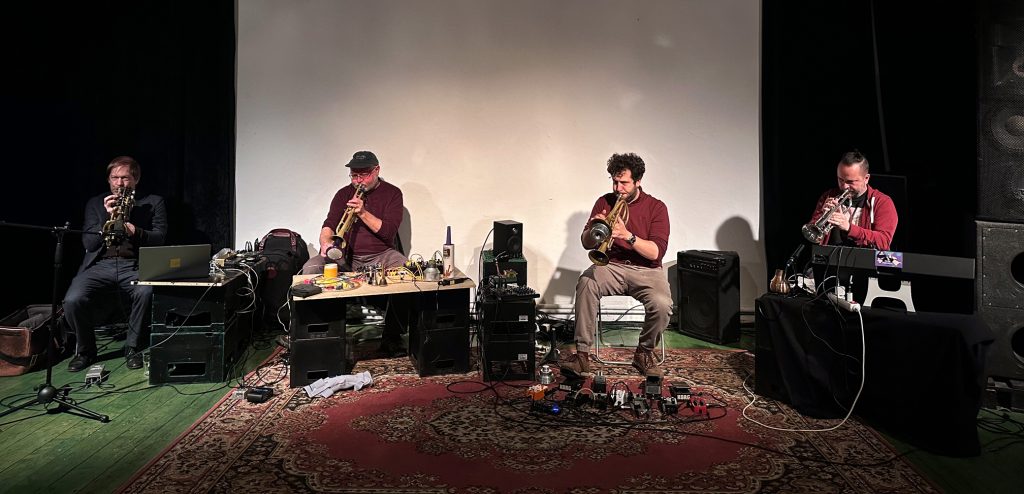
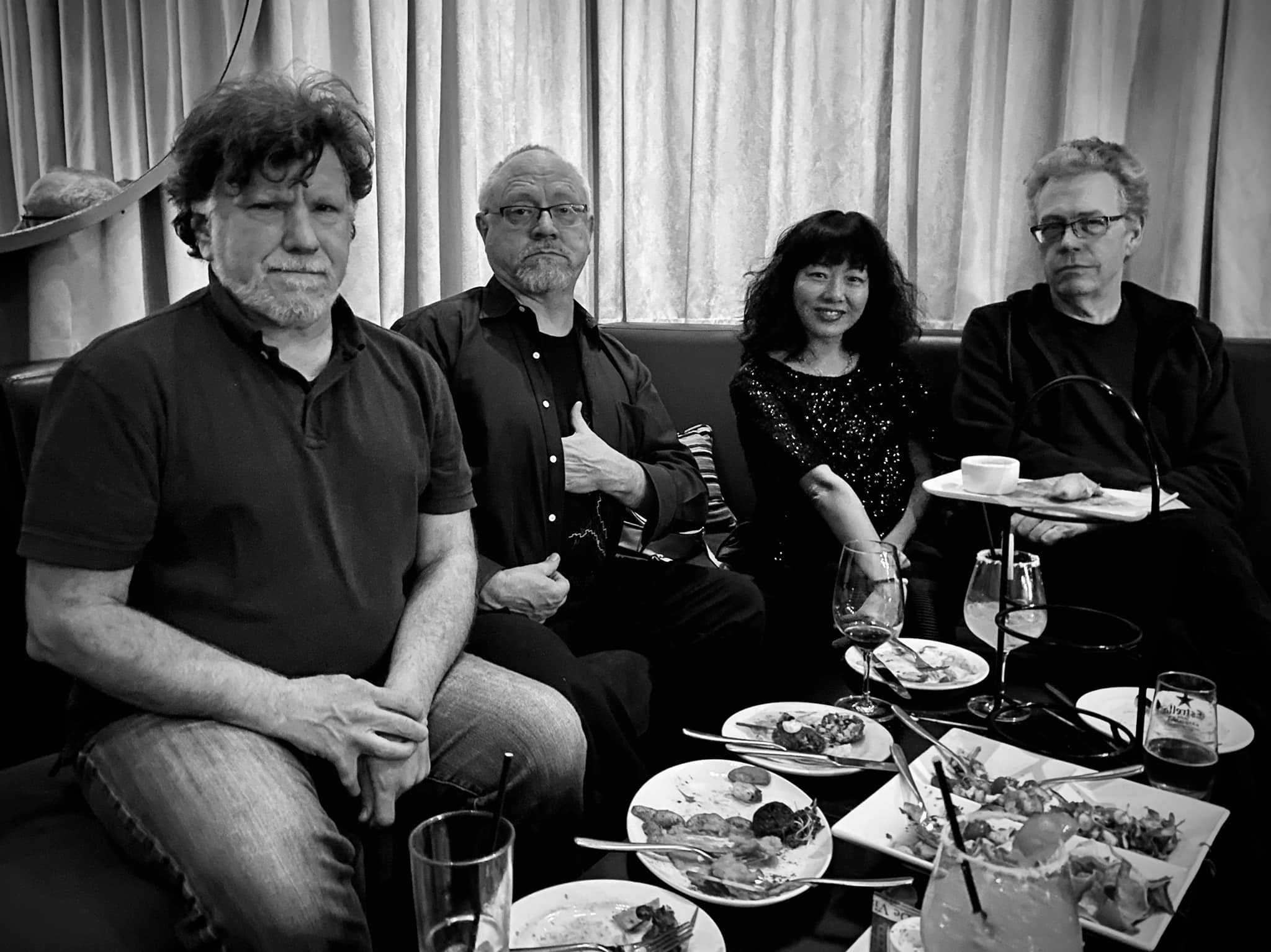
Here’s a shot of the quartet doing its thing in Prague. L-R Axel, me, Tassos, Petr (who also organized the whole 5-city tour):

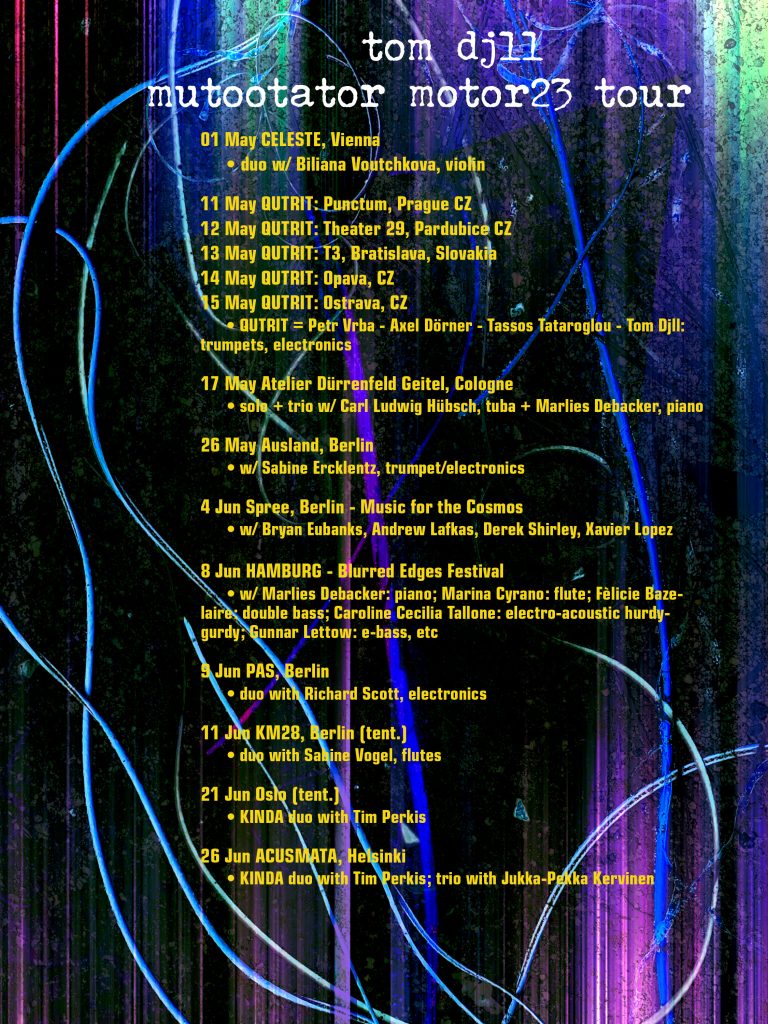
Greetings from Central Europe! Blogging from Vienna, where I kick off a nine-week tour taking its course from Vienna to Prague, around the Czech Republic, thence to Germany with three weeks in Berlin, up to Scandinavia and the Baltics.
Started off just last night with a lovely duo gig at CELESTE with Biliana Voutchkova, who is incredibly busy but somehow found time to play with me. The indefatigable Petr Vrba of Prague heard of my coming and put together a powerhouse quartet of extended trumpeters which came to be called QUTRIT: Axel Dörner, Petr Vrba, Tassos Tataroglou, and Djll. We’ll be doing five gigs in five days! — taking us into Slovakia as well as Czechia. Another day is set aside for rehearsing and recording.

My long-term duo partner Tim Perkis now lives in Gothenburg, Sweden. As KINDA GREEN we’ve been creating sonic disturbances since 2003, but we go back to 1996 at least (on my release Electro-Ecstatic). We just released our second collection of tracks, KINDA, on the Artifact Recordings imprint. We’re still setting up shows in Oslo, Gothenburg, Helsinki, and Vilnius.
See you soon!
It was a busy and ELEVATED fall season this year. I suspect partly because people were coming out of sequestration eagerly, and joyfully, seeking things to expand their lives. Expansion of minds and lives is, I suppose, the prime hoped-for result of my practice (if that doesn’t sound too grandiose). Hurray for social gatherings! Zooming it in just doesn’t cut it for me.
November opened with a solo trumpet + electronics set at the Luggage Store Gallery in downtown San Francisco, one of the longest-running new music series anywhere (over twenty years). A few days later my trio with Jacob Felix Heule (Sult, Voicehandler, Ettrick) and Chris Cooper (BSC, Caroliner Rainbow) opened for Zoh Amba and Wobbly in their duo at Tom’s Place in Berkeley.

This followed fast on the heels of a sold-out presentation at The Lab, a venerable Bay Area hotbed of experimentation in the arts. As part of the 2022 San Francisco Electronic Music Festival, I appeared with Gino Robair and the Rova Saxophone Quartet as the Rova Electric Six. This collaboration grew out of Rova’s ELECTRIC ASCENSION of January 2017 at SFJazz and flourished into its own at the 2019 Garden of Memory celebration in Oakland, where we alternated sets for four hours straight, eventually our segues turning into full-length sets of their own, in sonic celebration of the Summer Solstice.
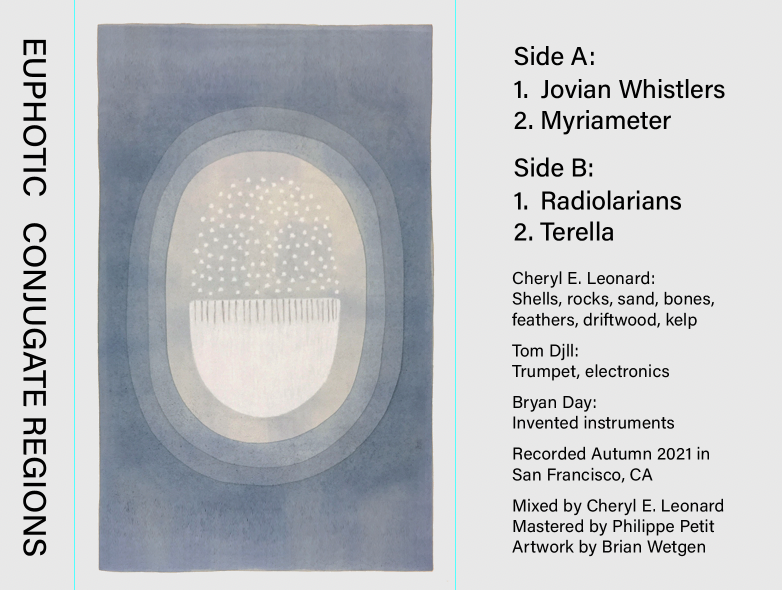
In September Euphotic (with Bryan Day and Cheryl Leonard) released CONJUGATE REGIONS on the Finnish label Ikuisuus. “The metallic sounds of Day’s wooden boxes with strings, played with sticks, bows, and fingers, set against the shaking and moving of natural objects by Leonard, make a very natural electro-acoustic sound. When Djll connects more with his electronics … such as in ‘Terella’, it all becomes very interesting…” Franz deWaard, Vital Weekly
I took a Western States road trip over the summer, with glorious activity in Portland, Denver and Santa Fe. Bassist Branden Abushanab and I played a duo in Denver that yielded a deep performance, considering it was a first-time encounter.
I’ll leave you with this short video recorded from my late mother’s house alongside the Columbia River in Washington state. I usually spend the holidays here, as it is something of a refuge. It was a morning when the temperature was barely above zero (-17° Centigrade) and I was in the middle of streaming a Solstice Drone audio piece from Ed Herrmann of KOPN radio to which many artists contributed, including myself. So that became the soundtrack for this haunting clip.

I have found myself saying, too often in the past three years: “There’s no new normal.” And here we are.
My life somehow continues in the wake of many personal losses over the last few years, most significant being my mother’s passing last January. This summer I spent six weeks on the road through the American West, seeing to my mother’s wish to have her remains scattered in the Columbia and Rio Grande rivers, rivers where she had spent significant time in her life, from 1972 until her death this past January 2022. Fifty years of rivers…
Along the way I made some music-adjacent noises in places like Santa Fe, Pueblo, Colorado Springs, Denver, and Portland. Made new friends and reaffirmed some choice vintage friendships, stretching back nearly (WOW) years. (see photo gallery at the bottom of this post)
The SF Bay Area [new, weird, experimental, whatever] music scene seems to be waking up this fall, for reals this time, as the damned plague waves go out with the tide. My schedule is filling up as it hasn’t in two and a half years. Feels nice. Life returns.
Tender Buttons dropped a new CD since the last time I checked in. It’s called an established color and cunning. The jacket features some artwork by my mother Mary Dill, and if I haven’t mentioned it before, you should get one for your collection. “As a texturally-driven communication, its palette is broad. An electronic library as rigorous as Skywalker Sound of swells, throbs, chugs, and bubbling, of bleeps, bloops, and clicks, of groans, oms, and roars from activated surfaces, something like fretless electric bass, the wet clapping valve of a heartbeat, and some radio transmission as if it was picked up through a feedback system rather than played in-house. Inside-piano strummed, plucked, and played on with ping pong balls and lonesome notes and ominous chords whose decay fades into that of the percussion.” — Keith Prosk, harmonicseries.org
Euphotic drops a new cassette this week: Conjugate Regions, on the IKUISUUS label, out of Finland.

Beyond the obvious fact that we each bring a distinct instrumental palette to the job at hand, I’ve never been able to put into words what makes Euphotic unique and so gosh-darned listenable (unlike Brand X ‘experimental music’). Each of the instruments Cheryl, Bryan and I deploy demands a distinct approach to playing and listening. The aggregate result — or more to the point, process — isn’t like anything else I can put my finger on. We’re listening but not reacting; we’re building something together but not with parts that are ready-made to fit; we’re walking together in this co-created soundscape but each taking note of different features within it. And, despite the differences in approach, often we can’t tell who’s doing what at any given moment. (This odd but by no means unheard-of problem comes up at rehearsal, again and again. Is it a feature rather than a bug?)
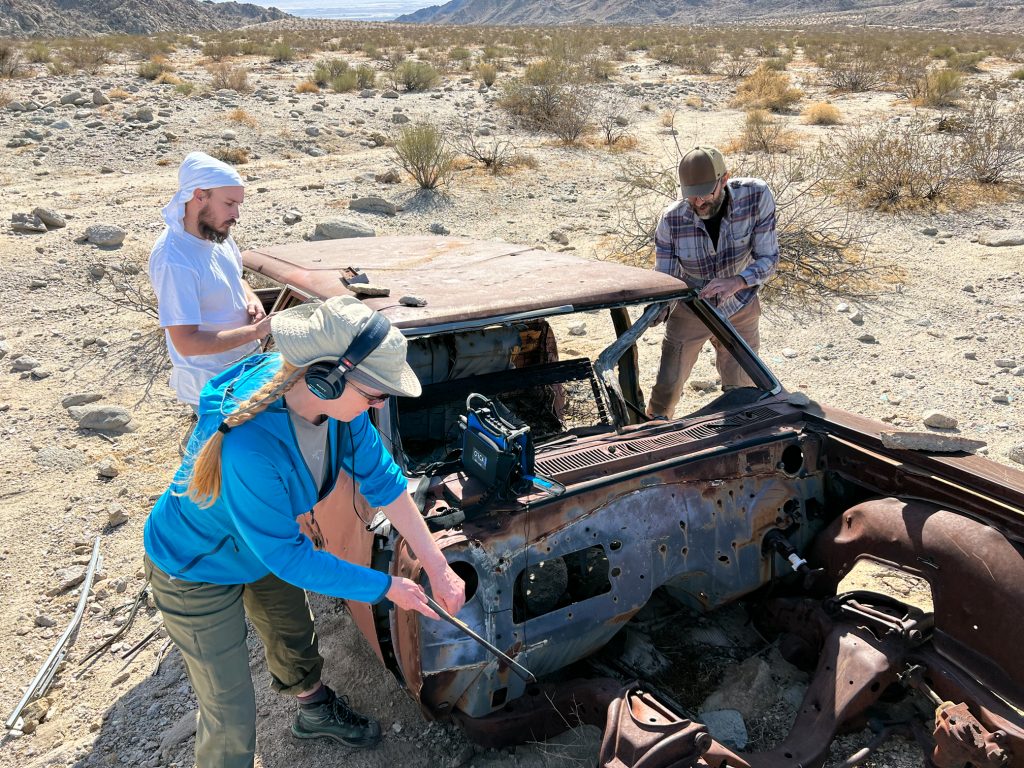
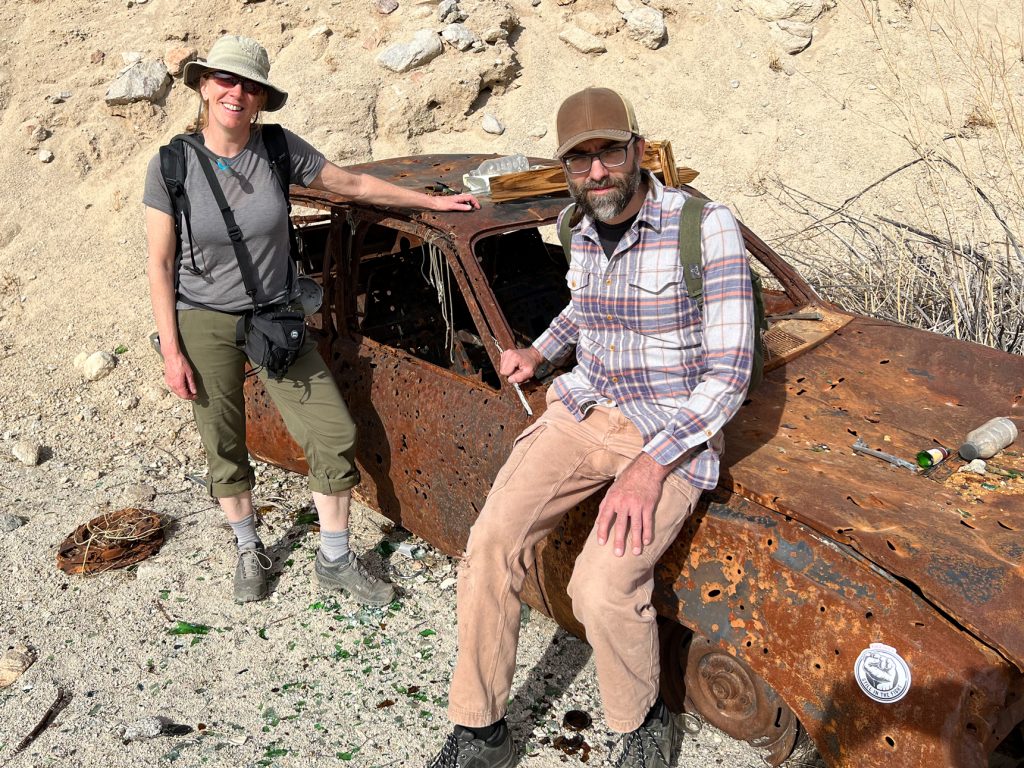
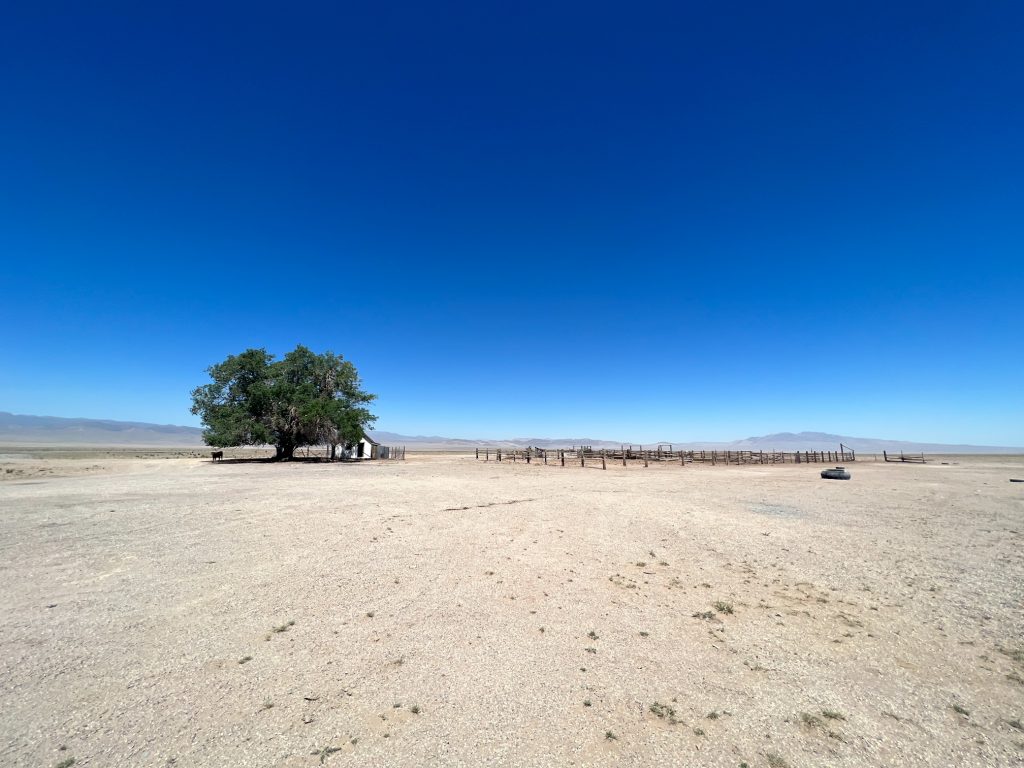
Last November (2021) Euphotic played the High Desert Soundings Festival, part of the burgeoning Inland Empire revival, if that’s a reasonable thing to call it. Maybe call it “Was Cheap Real Estate Before the Pandemic.” Anyway, we had a great time at the festival and also taking some high desert hikes with field-recording gear in tow, and managed to do some outback jamming on an abandoned box spring frame suspended over an abandoned well (and the expected abandoned cars, as shown). Cheryl even crawled into an old mine, which gave me the heebie-jeebies.


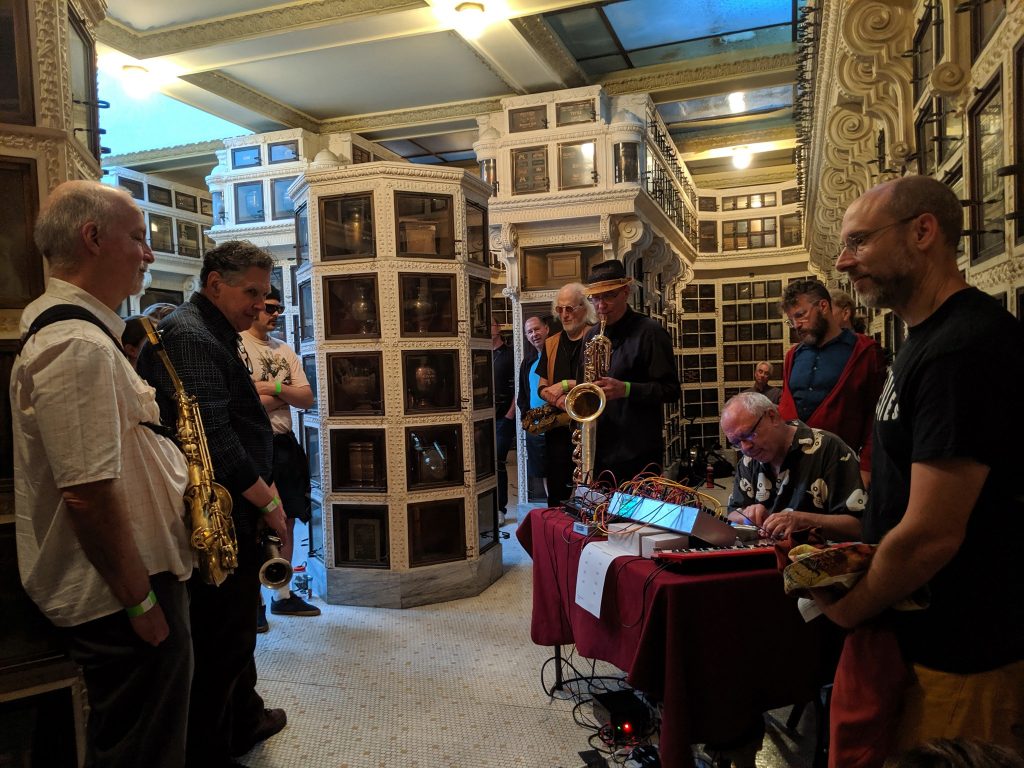
Coming up fast is the San Francisco Electronic Music Festival, in its twenty-first iteration, and for the closing set on closing night, I join Gino Robair and the Rova Saxophone Quartet in what is to be a freely improvised set of electroacoustic ear-stretching called the Rova Sonic Six, or Popular Tectonics, I’m not sure. What is sure is that we were kind of a hit at the 2019 Garden of Memory event (shown below) in the California Columbarium room at the Chapel of the Chimes in Oakland, and we’ve been plotting a reunion ever since. Because it was a blast.

Right now my builder genius Sam Cooper in Los Angeles is putting the finishing touches on a new Serge-format panel for me, which should get delivered in time to spice up the Rova/SFEMF gig:

I’m in the midst of planning a European jaunt for next spring, so there will likely be an update about that! … in about a year’s time. Berlin, Prague, Köln, Frankfurt, Copenhagen, Goteborg…
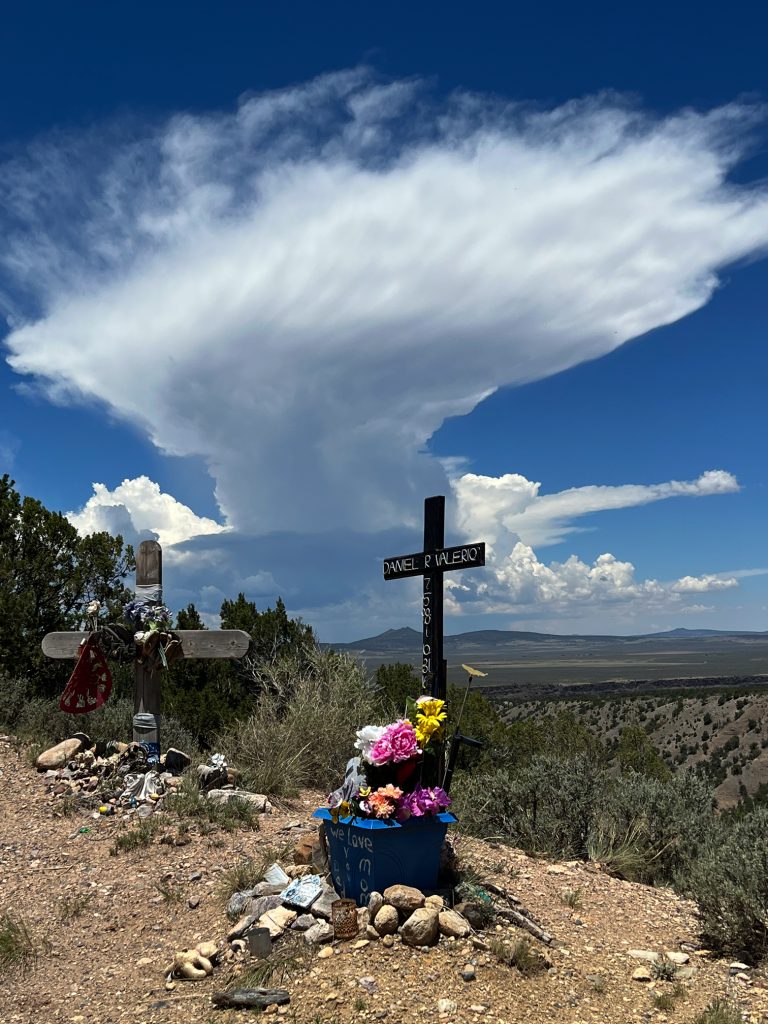
A gallery of shots from this summer’s tour:


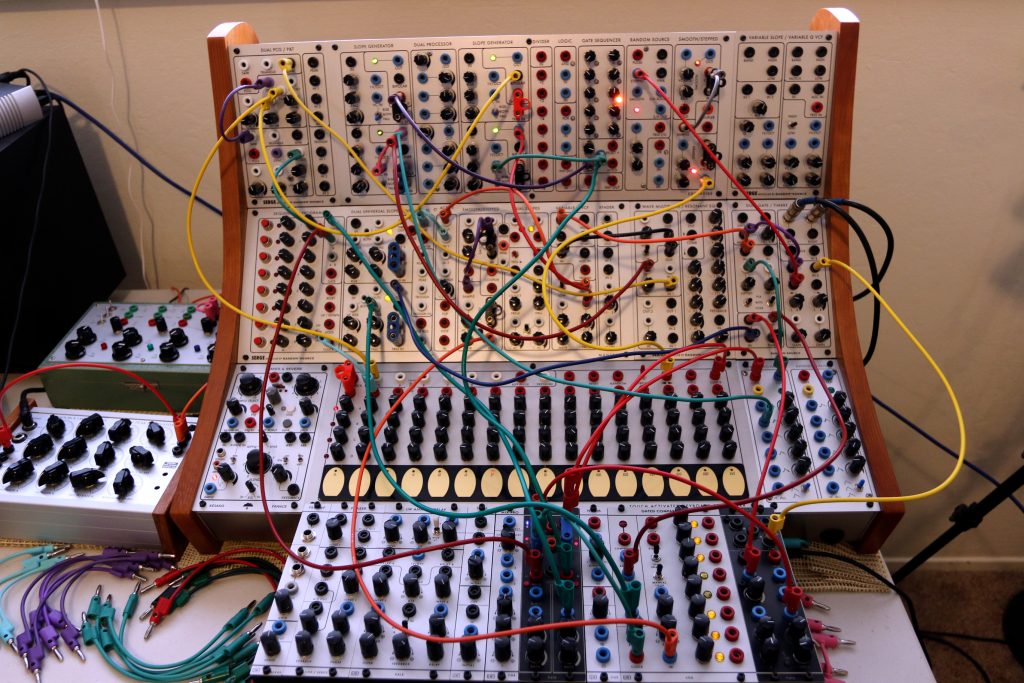
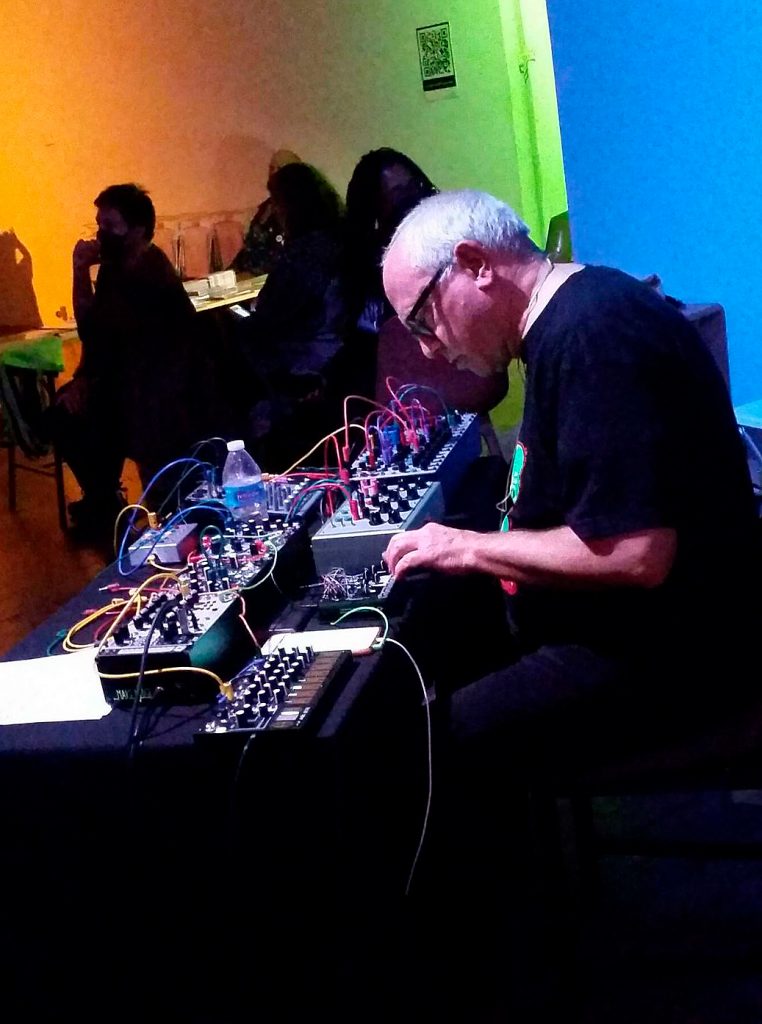
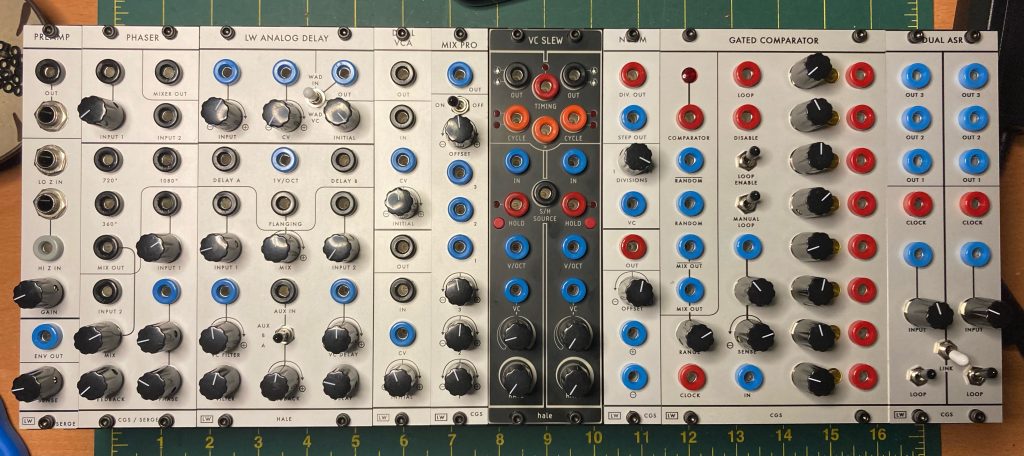
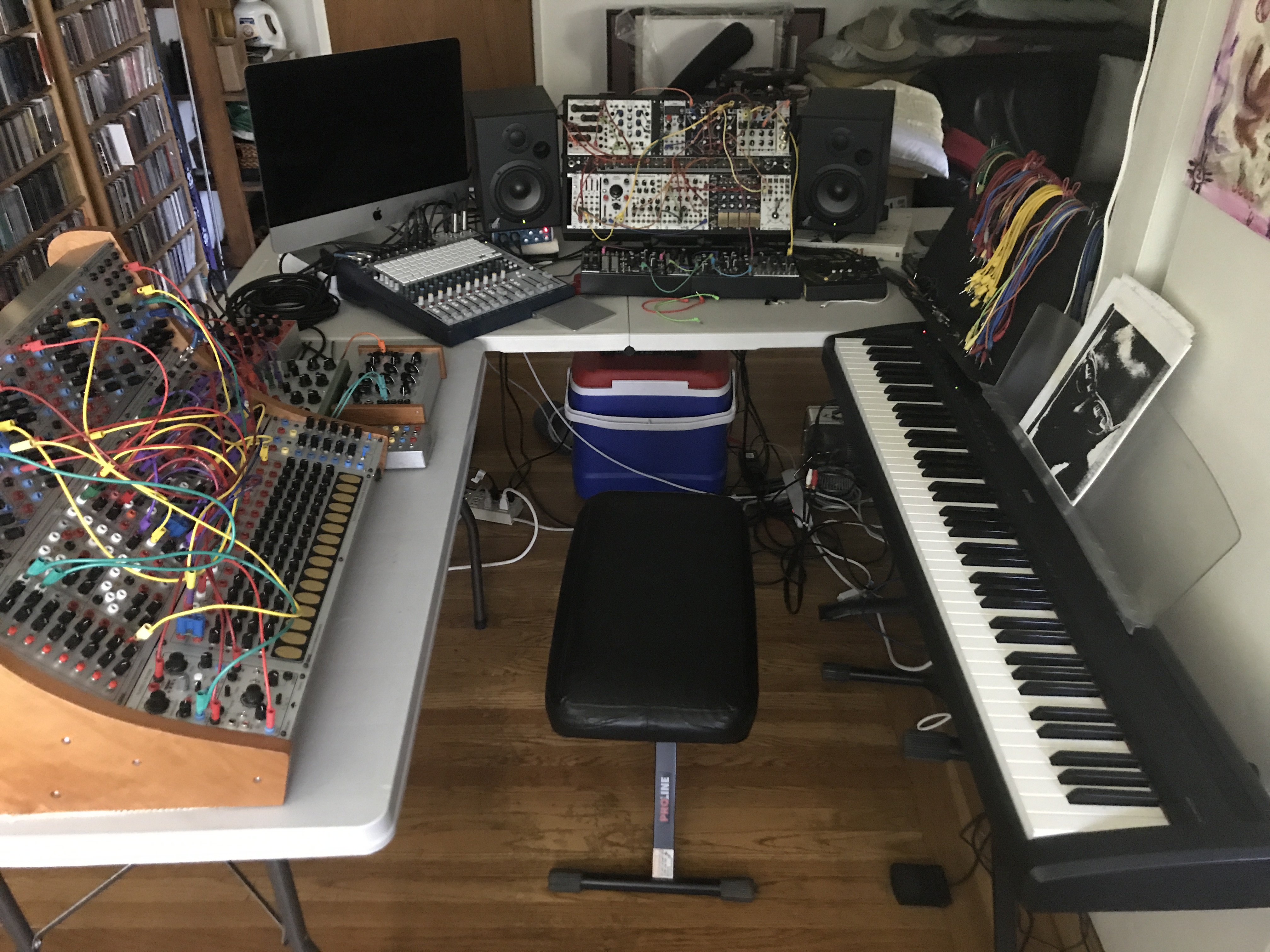
Current state of the studio, below. The big Serge triple-decker XL box in the top photo was finished in the first months of 2020 and I picked it up in June last year. I’ve been working on it intensively since I got home and I’m just recently feeling strong on it. I managed to not buy any gear during the pandemic (uh, except that Blippoo Box…) but recently broke that streak. New stuff still in transit but its advent perhaps may signal a whole new direction for djll musik. Spoiler alert: SPECTRAL RESYNTHESIS. ‘Nuff said.
In August 2020 I began a 13,000 mile road trip in a borrowed 24 foot RV, visiting family and friends and playing with people; all told, about 20 sessions in four months — which is respectable for such extreme times. Musical friends (some new) included Ross Rabin, Jay Kreimer, Miguel Frasconi, gabby fluke-mogul, Andrew Raffo Dewar, LaDonna Smith, Rob Cambre, and Donald Miller. September through half of December. Washington state, Colorado, Nebraska, Wisconsin, Kentucky, New England, New York, Georgia, Florida, Louisiana, Texas, Arizona… and back to California finally. The whole story is on my non-musical blog, Mutootator and Friends. Scroll down to the August 24 entry for the earliest post about the trip.
Euphotic managed to play one of the first live gigs in post-lockdown San Francisco a couple of weeks ago, at Canessa Gallery. Video here.
Euphotic’s new album came out last winter, YAY. And also the new one from Kokuo, BRITTLE FEEBLING, which you can find on Bandcamp. Which you should find, and purchase. Both scooped up a ton of nice reviews. I’m extremely happy with both these recordings. Tender Buttons‘ new album is not out quite yet, but soon. Like the first, it was recorded at Fantasy Studios in Berkeley, California — one of the last sessions done in that storied location, if not the very last.
I included a cut from that Tender Buttons unreleased recording in the set of music I shared with Mike Watt for his WATT FROM PE!DRO internet broadcast, which goes live today as I type. It’s three hours of music from djll and some other nobodies like John Coltrane, plus interviews. You can learn all about why I’m afraid of pigs (the four-legged kind) but not afraid of Captain Beefheart. (Photo of me hammering trumpet notes into the floor by Lenny Gonzalez!)